
This truly unique place is more than just a beautiful coastal temple complex, it’s filled with deep spiritual energy, fascinating stories, and ancient legends.
When the tide is high, the rock formation on which the temple stands is surrounded by the ocean, giving the appearance that it’s drifting on the waves.
Are you planning a trip to Bali?
This place definitely deserves a spot on your itinerary. Bali in Indonesia is full of beautiful locations and tourist attractions, which can sometimes make it difficult to decide where to go, but this is one place you shouldn’t miss. Not only is it historically fascinating, but it’s also expansive, visually stunning, and surrounded by impressive nature and views. Its spiritual atmosphere and overall ambiance add another unique layer to the experience.
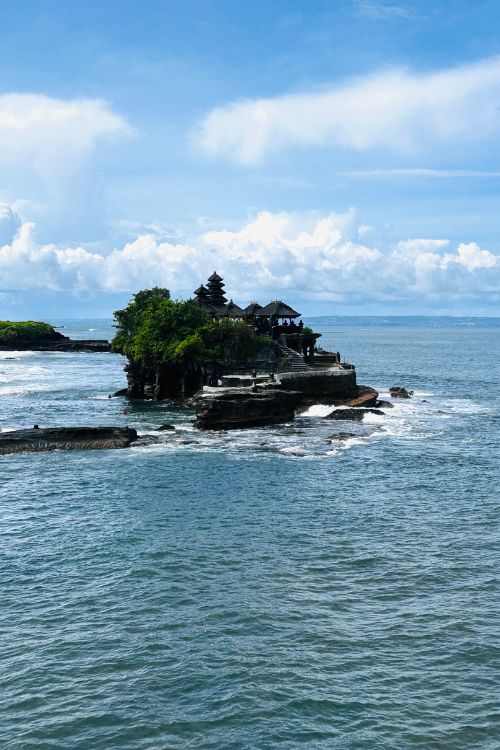

Tanah Lot is part of a system of seven “sea temples” that form a spiritual protective chain around the island. They were strategically built along Bali’s coastline so that each temple is visible from the next, creating both symbolic and spiritual protection against negative forces coming from the ocean.
The mysterious history of Tanah Lot Temple
The temple dates back to the 16th century and is associated with the Hindu priest Dang Hyang Nirartha. According to legend, he chose this location because of its strong spiritual energy and the light emerging from the sea.
Tanah Lot Temple is dedicated to the sea god Dewa Baruna, who in Balinese Hinduism represents the power of the ocean, its chaos as well as its balance. For locals, the ocean is not just a natural element, but a living entity that demands respect.
Legends about the origin of the Tanah Lot Temple
Tanah Lot is a place where reality naturally blends with legend and it’s precisely these stories that make it so unique.
One of the most famous legends says that Nirartha was asked by local villagers to leave the area. He refused and, using his spiritual power, is said to have moved a piece of land into the sea, creating the iconic rock on which the temple stands today.
Beneath the temple, there are caves inhabited by black-and-white sea snakes (Bungarus candidus), considered sacred. They are highly venomous, yet paradoxically, it is said they have never harmed a human. Locals believe they protect the temple from evil forces.
According to legend, Nirartha created them from his sash to guard the temple against negative energy and spirits. Tourists can view them up close, but always under the supervision of local guides, who emphasize their sacred nature.
Another mystery of Tanah Lot is a freshwater spring that emerges directly beneath the temple, just a few meters from the salty ocean. This spring is considered sacred and is used in purification rituals.
From a scientific perspective, it’s a fascinating geological phenomenon, but for locals, it’s further proof of the site’s spiritual power.
When is the best and worst time to visit the Tanah Lot Temple
Tourists most often visit at sunset, but that’s also when it’s at its most crowded. If you want to avoid the crowds, come as early in the morning as possible. I even managed to find quiet corners where I was completely alone, able to meditate and practice chi kung.
By the time I was leaving the complex around midday, it was already significantly busier. Many visitors were taking endless series of photos, so in some areas you can barely walk through without constantly stepping into someone’s shot.
Verdict: the most beautiful at sunset, but the most practical and least crowded early in the morning.
Rituals and offerings in Tanah Lot Temple
Every day, small rituals and offerings (canang sari) take place here to maintain harmony between humans and natural forces. Larger ceremonies are held during important Balinese festivals, when the temple becomes a center of spiritual activity.
Interestingly, entry into the temple itself is forbidden for tourists, only worshippers are allowed inside. The area is very large, so there’s still plenty of space where you can walk around, only a few sections are closed for tourists. You’ll also find a large lawn where you can have a picnic or relax.
The best way to get there is by your own bike
If you’re taking a taxi, watch out for this: you can easily get there using apps like Gojek or Grab, but getting back is another story. Drivers from these apps usually won’t pick you up there due to local agreements that prevent them from operating in the area. Instead, only car transport is offered on-site and it’s significantly overpriced.
Even if you manage to call a bike taxi, there’s often a local security guard an unpleasant, overly assertive guy, who will tell your driver not to pick you up. He’ll insist you either take his car or walk about 2 km away before a bike taxi is allowed to collect you.
I saw several tourists forced to walk this distance. I managed to negotiate with a passing driver—we agreed I’d walk a bit first, and once we were out of sight of the security guard, he picked me up.
Pridaj komentár